Get ready for a cosmic adventure with 10 fascinating facts about space and astronomy. We’ll explore the universe’s vastness and the mysteries of black holes. This journey will leave you amazed by the wonders beyond our planet.
Space and astronomy have always sparked human curiosity, driving us to explore the cosmos. Let’s dive into the world of space facts and discover what makes our universe special. We’ll cover everything from galaxy sizes to the mysteries of stars.
This article is for anyone interested in space, whether you’re an expert or just starting out. Get ready to be amazed as we reveal the secrets of the universe. We’ll explore the wonders that shape our understanding of the cosmos.
Unveiling the Mysteries of the Universe
Get ready for an exciting journey into the cosmos. We’ll explore the universe and find the amazing wonders waiting for us. It’s full of mysteries, wonders, and phenomena that amaze and inspire us. From the vastness of space to stunning stars, there’s so much to discover.
Explore the Wonders of the Cosmos
Looking deeper into the universe shows us incredible things that make us rethink our world. The universe is huge, with galaxies and stars stretching far and wide. Thanks to science, we get to learn about the mysteries that have always fascinated us.
Prepare to be Amazed
The universe shows us incredible sights, like the dance of stars and the beauty of supernovae. As we learn more, we’re always amazed by how complex and beautiful the universe is. Let’s dive into the cosmos together and uncover the secrets that have intrigued us for so long.
The Vastness of Space
Get ready to be amazed by the huge scale of space. The universe’s size is hard to wrap our heads around. When we look up at the night sky, we see a small part of the vast space around our planet. But the real size of the universe is much, much bigger than we can imagine.
Stars and planets are far apart, measured in light-years. A light-year is how far light travels in one year, which is about 6 trillion miles (9.5 trillion kilometers). The closest star to us, Proxima Centauri, is 4.2 light-years away. The Milky Way galaxy, our home, stretches from 100,000 to 180,000 light-years wide.
Our galaxy is just a small part of the universe. The universe we can see stretches 93 billion light-years wide. It has trillions of galaxies, each with stars, planets, and wonders. The universe’s huge size makes us realize how small we are in the universe.
Fun Facts About the Milky Way Galaxy
Get ready to be amazed by our Milky Way Galaxy, the home we live in. It’s a cosmic wonder filled with breathtaking sights and fascinating facts. These will leave you in awe of the universe’s grandeur.
Our Cosmic Home
The Milky Way Galaxy stretches over 100,000 light-years wide. It’s a spiral galaxy and our home. It has between 200 billion to 400 billion stars, each with its own story.
Imagine the scale of our galaxy. It would take a spacecraft over 100,000 years to cross it at the speed of light!
Galactic Wonders Unveiled
The Milky Way Galaxy looks like a hazy band of stars and dust in the night sky. But there’s much more to see. Astronomers have found supermassive black holes and exoplanets.
Each discovery reveals more about our galaxy. It invites us to explore the depths of space.
Breathtaking Stellar Phenomena
Get ready to be amazed by the stunning events in the universe. From beautiful auroras to stunning nebulae, these cosmic light shows highlight the stars’ incredible power and beauty.
Nature’s Cosmic Spectacles
See the stunning events that light up the night sky. Auroras create a beautiful dance of light in the atmosphere. They show us colors like green, purple, and red.
Nebulae are huge clouds of gas and dust that shine brightly. They light up with the glow of new stars. These nebulae are like celestial art that takes our breath away.
These cosmic events are not just pretty views. They are active, changing scenes that make us think about the universe’s size and complexity. From the beautiful patterns of star nurseries to the amazing explosions of supernovae, the universe shows its power and beauty through these events.
Fun Facts About Exoplanets
Step into the universe and explore exoplanets, planets that orbit stars other than our Sun. These worlds are full of surprises, showing us how vast and diverse the universe is.
Exoplanets come in all sizes, from bigger than Jupiter to smaller than Earth. They show us the universe’s endless creativity with their unique shapes and sizes. These extrasolar planets are truly amazing.
Exoplanet systems are full of surprises too. While our planets move in circles, many exoplanets have paths that take them close to their stars. These discoveries are changing how we think about how planets form and change over time.
As we learn more about exoplanets, we’re finding out more about the universe and if there’s life out there. The study of these distant worlds is full of possibilities. We’re excited to see what we’ll discover next about alien worlds.
The Mysteries of Black Holes
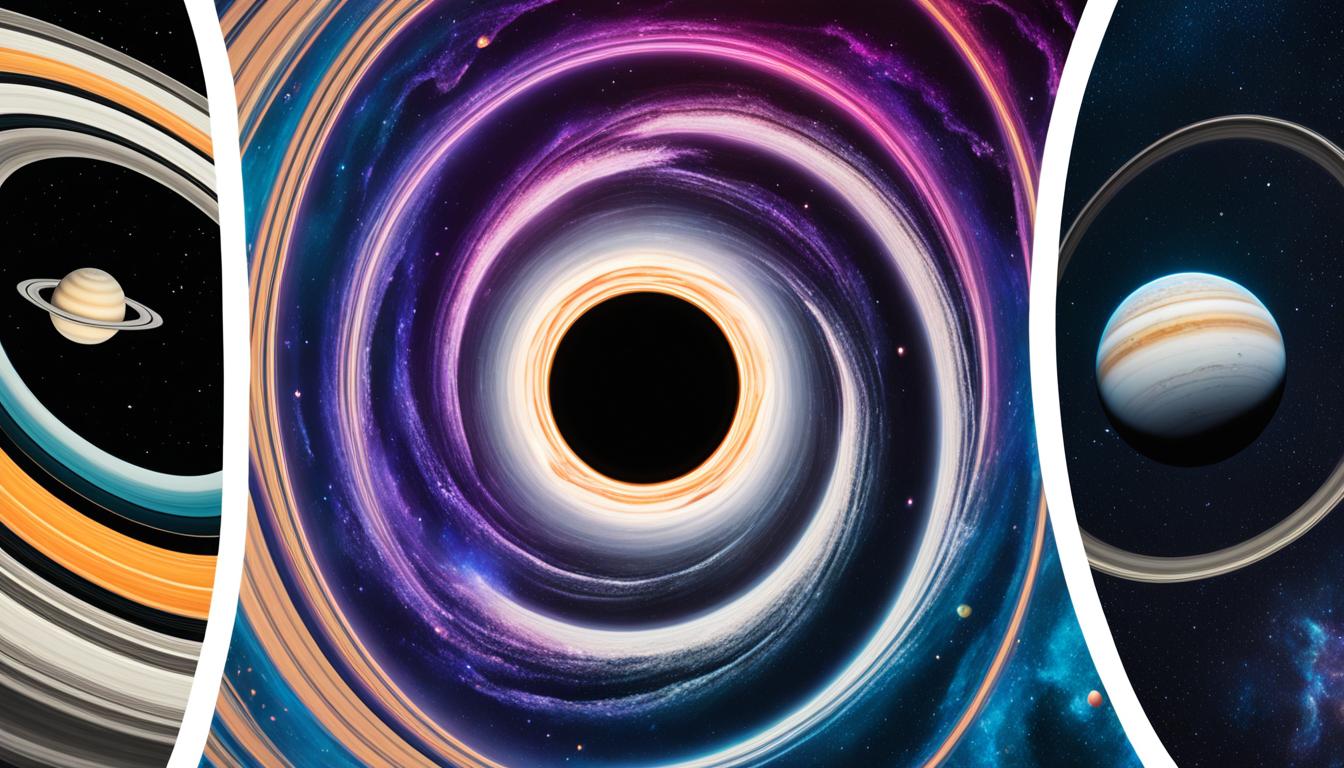
Explore the fascinating world of black holes, where physics doesn’t apply and the universe’s secrets are revealed. These cosmic mysteries have always intrigued astronomers and scientists. They study black holes to learn about spacetime and the universe’s nature.
Unveiling the Cosmic Enigmas
Black holes are mysterious and amazing in the universe. They form when a huge star collapses, creating a strong gravity that even light can’t escape. Scientists have long tried to understand black holes and their effect on the universe.

They are studying the mind-bending singularity and the strange Hawking radiation. These studies help us learn more about the universe. They push us to understand space, time, and reality better.
Astronomical Discoveries That Shaped Our Understanding
The history of astronomy is filled with key discoveries that changed how we see the universe. From the first telescope to finding gravitational waves, these moments changed our view of space. They also led to new areas to explore.
The invention of the telescope was a big step. It let astronomers see the stars and planets up close. This led to new discoveries like finding other planets and understanding the Milky Way.
Then, finding gravitational waves was a huge deal. Albert Einstein had predicted them, and scientists proved it was true. This win of the Nobel Prize in Physics showed us a new way to study the universe. It opened doors to learning more about black holes and other mysteries.
These discoveries have greatly changed what we know about space. They led to new theories and ways to explore the universe. As we keep learning, these discoveries will keep shaping our view of the cosmos and our place in it.
Fun Facts About the International Space Station
The International Space Station (ISS) is a huge achievement in engineering and science. It’s a place where humans live in space and do important research. This has helped us learn more about the universe and how space affects life.
Humanity’s Orbiting Outpost
The ISS floats in space about 250 miles above Earth. It was made by five space agencies: NASA, Roscosmos, ESA, JAXA, and CSA. Since November 2000, astronauts have lived there, showing what we can do in space.
The ISS is huge, as big as a football field. It’s the biggest thing made by humans in space, weighing almost a billion pounds. It has labs, homes, and tools for scientists to do research in space.
Another cool thing about the ISS is how long it has been in space. Over 240 people from 19 countries have stayed there. This has let scientists do lots of research in space, teaching us a lot about living in space.
Celestial Events to Watch Out For
Get ready for amazing astronomical events in the sky. From beautiful meteor showers to rare lunar eclipses, check out the cosmic calendar. Discover the stunning celestial phenomena you should see in the next few years.
Stargazers and sky lovers, set your calendars! The universe has a fantastic list of celestial events coming up. In 2024, a total solar eclipse will cross North America. It’s a rare chance to see the moon block the sun’s light completely.
Later that year, the Perseid meteor shower will light up the night sky. You might see up to 100 shooting stars per hour. It’s a sight you won’t forget.

In 2025, a stunning lunar eclipse will happen, making the moon look deep red. This is called a “blood moon.” It shows how our celestial friends move together.
And in 2026, the Orionid meteor shower will reach its peak. It’s known for its fast and bright meteors. This event will surely leave a mark on sky watchers.
The cosmic calendar is full of amazing astronomical wonders. By watching these events, you can dive into the universe’s beauty. And you’ll make memories that last a lifetime under the stars.
The Role of Astronomy in Advancing Human Knowledge
Astronomy has always led our quest to understand the universe. By looking at stars, planets, and cosmic events, astronomers have made big discoveries. These discoveries have changed how we see the world.
From Galileo Galilei’s early observations to Albert Einstein’s groundbreaking theories, astronomy has driven major scientific advances. Every new discovery in space helps us learn more, question what we thought we knew, and leads to new inventions that change our lives.
Unlocking the Secrets of the Universe
Astronomy has shown us our place in the universe. By studying distant galaxies, planets, and mysteries like black holes, we’ve learned a lot about the world. These discoveries have made us wonder about the nature of existence.