Get ready for an exciting journey through our solar system! We’ll share 10 amazing facts that will amaze you. You’ll learn about the size of our planets and the mysteries that astronomers are still trying to figure out. This journey will make you see the universe in a whole new light. Prepare to have your view of the solar system completely changed!
Unveiling the Vastness of Our Solar System
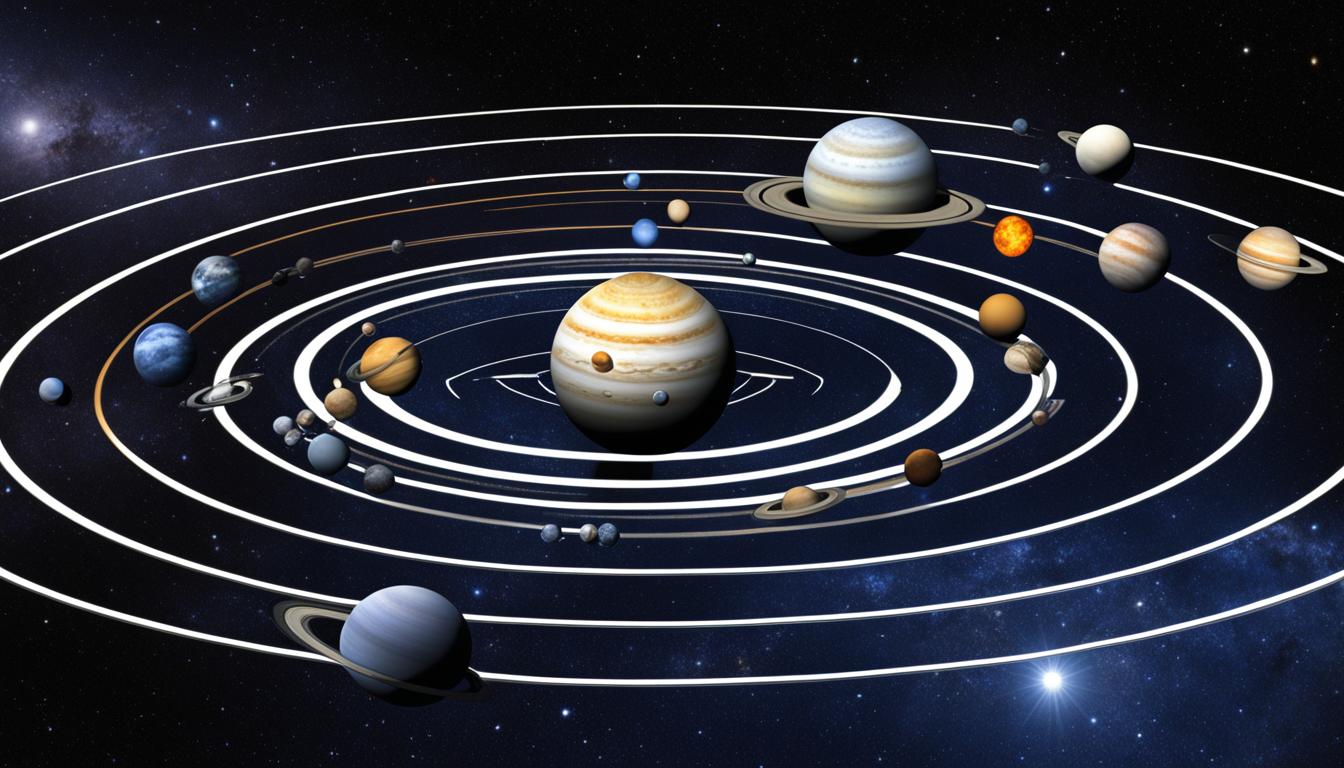
Our solar system is vast and captivating, stretching far beyond Earth. It goes from the tiny Mercury to the icy dwarf worlds of the Kuiper Belt. The scale is truly mind-boggling.
New discoveries keep astronomers enchanted and intrigued. They show the complexity and diversity of planets, moons, and other celestial bodies. This makes our cosmic neighborhood fascinating.
Celestial Wonders Await Discovery
Space exploration missions by agencies like NASA reveal new insights. They tell us about the size, structure, and dynamics of our solar system. The distances between planets and the galaxy’s scale create awe and wonder.
From Mars’ towering Olympus Mons to Saturn’s mesmerizing rings, our solar system is full of wonders. These are waiting to be explored and understood.
Exploring the Realms Beyond Earth
Our understanding of the solar system is growing, making space exploration more appealing. Robotic probes and human missions are pushing our knowledge. They are shedding light on the universe’s nature.
The search for habitable exoplanets and the mysteries of dark matter and dark energy are ongoing. The realms beyond Earth promise groundbreaking discoveries. These could change how we see our place in the cosmos.
The Sun: Our Cosmic Powerhouse
At the center of our solar system, the Sun shines brightly. It is the main source of energy and light for our planet and others. The Sun’s energy comes from nuclear fusion, which gives us warmth and light. It also helps life on Earth by supporting photosynthesis.
The Sun is a huge ball of hot plasma. It makes a lot of solar energy by fusing hydrogen atoms in its core. This energy then spreads out, warming and lighting up the planets and moons.
Without the Sun’s energy, life on Earth wouldn’t exist. Photosynthesis, which is key for plants and animals, needs the Sun’s rays to happen.
The Sun is incredibly big and powerful. It’s about 1.4 million kilometers wide and makes up almost all of the solar system’s mass. Its gravity keeps the planets in orbit, keeping our solar system stable.
The Sun’s rays also shape our weather and climate. They are vital for our planet’s ecosystem.
Fun Facts About the Planets
Our solar system is filled with diverse and captivating planets. Each one has its own unique features and intriguing characteristics. From the small but dense Mercury to the hot Venus, often called Earth’s twin, these worlds amaze us.
Mercury: The Smallest but Mightiest
Mercury is the smallest planet in our solar system but it’s mighty. It’s the closest to the Sun and its surface has many craters. These craters show how much it has been hit over time.
Even though it’s small, Mercury is dense and strong. It has a powerful magnetic field that protects it from the Sun’s harmful radiation.
Venus: Earth’s Sweltering Twin
Venus is often called Earth’s twin but it’s very different. It has a thick atmosphere that makes it extremely hot. The surface of Venus is hot enough to melt lead.
This heat comes from a strong greenhouse effect that traps the Sun’s energy. Despite being hostile to life, Venus interests scientists and space fans. They are trying to learn more about this unique planet.

Earth: Our Beloved Home Planet
Earth is a standout in our solar system, a world full of life and complex systems. It’s our blue planet, a place where everything works together perfectly. From its green lands to the thin layer of air around it, Earth is a cosmic wonder we should all care for deeply.
The climate of our planet is complex, changing all the time. It’s shaped by many things, some natural, some made by humans. As we learn more about our home planet, we see the need for sustainability. We must take good care of this earth for the future.
Science and exploration let us see the beauty of our blue planet. They show us how delicate life is here. By taking care of our environment, we help our earth stay healthy. This shows how strong and flexible nature can be.
Mars: The Red Planet’s Allure
Mars, known as the “Red Planet,” is a fascinating mystery in our solar system. Its deep red color and mysterious surface have always drawn astronomers and space fans. NASA and other space agencies are working hard to learn more about Mars.
Many think Mars might have once had water, which is important for life. Scientists use rovers and landers to study Mars. They look for signs of life and map the planet’s tough terrain.
Now, there’s talk about sending humans to Mars. This idea excites space agencies, companies, and people everywhere. The challenge is huge, but the benefits could be huge too.
Mars keeps inspiring us to explore and solve its mysteries. Whether it’s finding life, studying its geology, or thinking about humans living there, Mars is a constant source of wonder.
Jupiter: The Giant of the Solar System
Jupiter is the biggest planet in our solar system. It’s a huge world filled with gases and massive storms. Its size is huge, bigger than all other planets. It has a storm called the Great Red Spot, which is bigger than Earth.
Unveiling the Grandeur of the Gas Giant
Studying Jupiter reveals many interesting facts about its size and complexity. It has moons, including four big ones found by Galileo. Jupiter’s storms are also fascinating, showing its unique nature in our solar system.

Jupiter is the biggest planet and affects the whole solar system with its gravity. Exploring Jupiter shows us how much we don’t know about it. This makes us more curious about space and its secrets.
Fun Facts About the Outer Planets
The outer planets, Saturn, Uranus, and Neptune, are huge and full of mysteries. They are gas giants that astronomers and space fans love. Let’s dive into some cool facts about these planets.
Saturn is famous for its beautiful rings. These rings are made of ice and rock and stretch up to 300,000 kilometers wide. Saturn also has moons like Titan, which might have life.
Uranus is the third biggest planet and spins on its side. This tilt leads to extreme seasons and might have been caused by a big crash long ago. It looks blue-green because of methane in its air.
Neptune is the farthest planet from the Sun and has a deep blue color from methane in its air. It has the fastest winds in the solar system, up to 2,100 kilometers per hour. Neptune’s moon, Triton, has a surface of frozen nitrogen and geysers.
The outer planets amaze us with their size and special features. They help us learn about our solar system’s creation and evolution. By exploring these gas giants, we gain new insights into the universe.
Saturn: Lord of the Rings
Saturn is a true marvel in our solar system. It’s famous for its stunning ring system. These rings are made of icy particles and are a wonder to see.
But Saturn isn’t just about its rings. It has many moons, each special in its own way. Titan, its biggest moon, has a thick atmosphere. Through missions like Cassini, we learn more about Saturn and its moons.
Mesmerizing Celestial Jewels
The rings of Saturn are a sight to see. They’re made up of billions of icy particles, from tiny to huge. The way they move and look is amazing.
The Cassini mission showed us Saturn in a new light. NASA, the European Space Agency, and the Italian Space Agency worked together. They gave us a lot of information about Saturn’s weather, its rings, and more.
Uranus and Neptune: The Ice Giants
We’re now exploring the outer reaches of our solar system, meeting the ice giants Uranus and Neptune. These planets are far away and full of mysteries. They show us how diverse and complex our solar system is. By studying them, we learn new things that make us wonder about the universe.
Uranus is the seventh planet from the Sun and spins on its side. This tilt leads to extreme seasons on the planet. Its blue-green color comes from methane in its air, which hides red light. Uranus has many moons like Miranda, Ariel, Umbriel, Titania, and Oberon, offering lots of chances for discovery.
Neptune is the eighth and outermost planet, a true ice giant. It has a dense core and a thick atmosphere of hydrogen, helium, and other gases. Its blue color comes from methane, making it stand out. The moon Triton, with its possible ocean beneath the ice, makes Neptune interesting for finding life in our solar system.