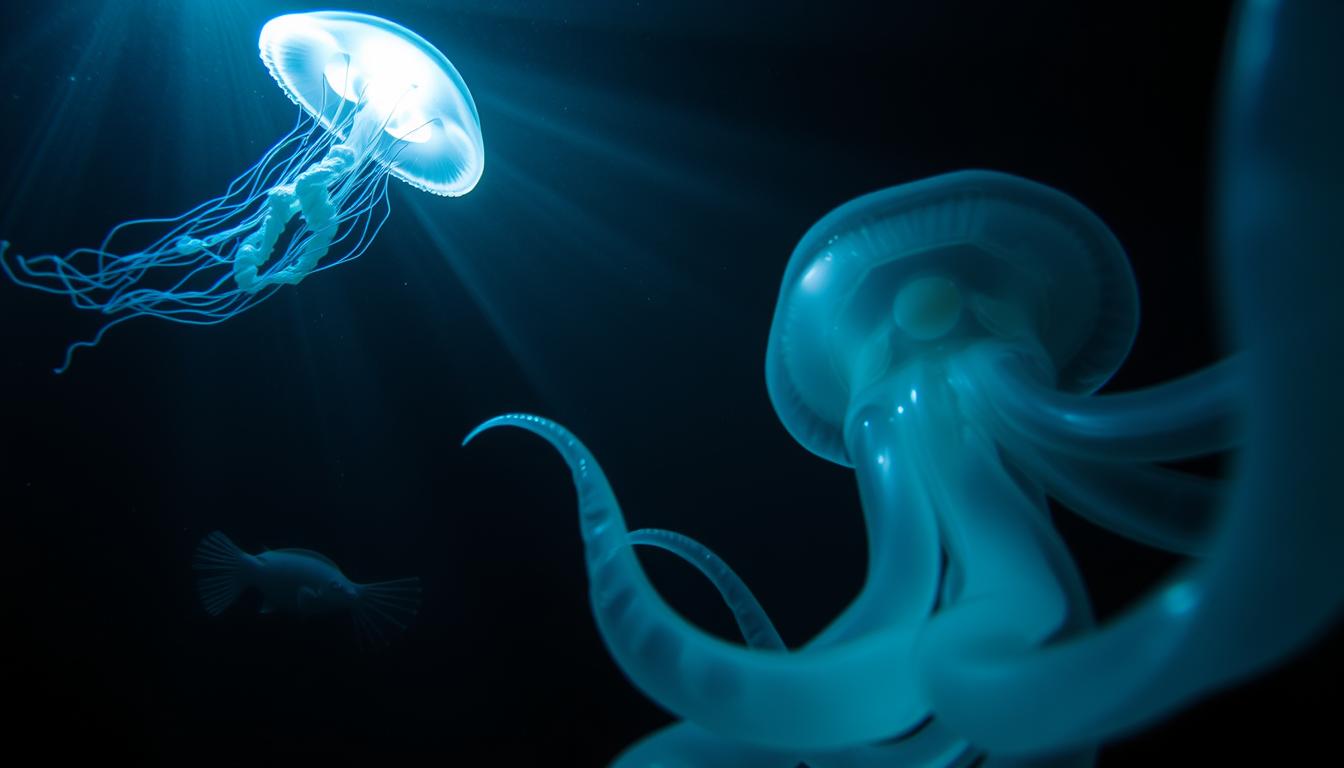
The ocean is full of amazing sea creatures that amaze and inspire us. Only 5% of the world’s oceans have been explored. This means there’s a lot more to find in the deep sea.
The bluntnose sixgill shark is one such creature. It can grow up to 20 feet long and weigh over 1,000 kilograms. Seeing one is truly a remarkable experience.
Imagine finding creatures in the ocean that look like they’re from a science fiction movie. The deep sea is full of mysteries. Its dark depths and strange sea creatures are incredible.
We will explore the deep-sea world and why we need to keep researching the ocean. With 71% of the planet covered in water, there’s a lot to discover about the ocean and its creatures.
The Fascinating World of Deep-Sea Ecosystems
The ocean is a complex and fascinating ecosystem. It supports a wide range of marine life, from tiny plankton to massive squid. The deep sea has unique conditions, like extreme pressure and near-total darkness. Yet, it’s home to a vast array of creatures that have adapted in remarkable ways.
Deep-sea ecosystems are fascinating because of how marine life has evolved. For instance, some fish have big eyes to make up for the lack of light. Others can produce their own light. The ocean floor also has features like hydrothermal vents. These vents support a wide range of marine life that can survive in harsh conditions.
Exploring the deep sea is key to understanding its importance. By studying the ocean and its inhabitants, we learn about the complex relationships between marine life and their environments. This knowledge helps us protect these ecosystems for future generations.
Bioluminescent Creatures: Nature’s Light Show
In the depths of the ocean, a world of glowing wonders awaits. Bioluminescent sea creatures have evolved to produce their own light. This has fascinated humans for centuries. With about 1,500 known species of fish showing bioluminescence, it’s a vital tool for them.
From glowing jellyfish to sparkling squid, these creatures show the incredible diversity of deep-sea life. Most bioluminescence in the ocean is blue-green light, which travels far underwater. Some, like the dragonfish, can even see and emit red light, a rare ability in the deep.

Bioluminescence helps these creatures attract prey, signal mates, and defend against predators. Some, like the green bomber worm, can release bioluminescent “bombs” to defend themselves. Exploring the ocean and its creatures reminds us of the need to protect them and their homes.
With 76 percent of ocean animals being bioluminescent, it’s clear this phenomenon is key to the marine ecosystem. As we explore bioluminescent creatures, we find a world of glowing wonders. Each has its own unique traits and abilities. Studying bioluminescence helps us understand the complex relationships between sea creatures and their environment.
The Science Behind Deep-Sea Exploration
Exploring the ocean is key to understanding marine life ecosystems. The ocean makes up about 70% of Earth’s surface. It’s vital for our economy and survival. New tech in ocean exploration lets us dive deeper into marine worlds.
Exploring the ocean helps us deal with natural disasters like earthquakes and tsunamis. Marine life could lead to new medicines, food, and energy sources. For example, ocean microbes have compounds in clinical trials for diseases.
The deep ocean goes from 200 m to almost 11,000 m below sea level. It’s a vast, mysterious area. By exploring and studying the ocean and its marine life, we learn more about our planet.
Strange Deep-Sea Fish That Defy Logic
The ocean is full of sea creatures, including deep-sea fish. These fish have special features to survive in the deep sea. For example, the anglerfish has a glowing lure on its head to catch prey. The female anglerfish can grow up to 4 feet long, while the male is only about 5.5 inches.
The gulper eel is another strange fish, growing up to 6 feet long. It lives in depths of 10,000 to 16,000 feet. The Pacific viperfish has big teeth and a glowing belly, found at depths of 1,000 to 4,000 meters. These fish use their glow to attract prey and talk to other fish in the dark sea.

The deep sea is vast and full of mysteries. The fangtooth fish has huge teeth and can eat prey whole. It can be found up to 16,000 feet deep. The goblin shark is also strange, with a pinkish-brown color and a long, flabby body that can reach up to 20 feet.
These ocean creatures are just a few of the many found in the deep sea. By studying them, we learn about the deep sea’s complex ecosystems. We also discover how these creatures adapt to live in such a harsh environment.
Unusual Invertebrates of the Depths
The ocean is full of invertebrates, like giant squid and sea sponges. There are also delicate sea fans and colorful corals. These creatures have special features, like glowing bodies and strong beaks, to live in the deep sea.
There are over 3,000 types of nudibranchs in the ocean, from shallow to deep waters. This shows how diverse marine life is in the deep sea.
In the deep sea, you can find amazing creatures like giant isopods and giant squid. The ocean is key to supporting this variety of marine life. We must keep exploring and learning about these incredible beings.
The deep sea is mostly unexplored, and new species are found all the time. Almost two-thirds of sea floor life hasn’t been named yet. Over 500 new species live in the ocean‘s deepest parts.
As we explore the deep sea, we see why it’s vital to protect these unique places. And the amazing marine life they support.
Predators and Prey: The Circle of Life
In the vast ocean, a delicate balance exists between sea creatures. Each plays a vital role in the ecosystem. Creatures like squid and fish are key players in this balance. This balance is essential for the health of the ocean and its inhabitants.
Research shows that sea creatures behavior impacts the ecosystem. For instance, studying sea otters in kelp forests has been ongoing for decades. Also, sea urchins now actively forage in kelp forests, showing changes in predator-prey dynamics. These shifts can affect the ocean ecosystem balance.

Keeping this balance is critical. The ocean is a complex system. Changes in one part can have big effects elsewhere. For example, less oxygen in deep ocean waters during the last ice age was due to sea ice blocking oxygen. This shows the need for ongoing research and monitoring of the ocean and its inhabitants.
Colorful Coral Reefs: Biodiversity Hotspots
Coral reefs are some of the most diverse ecosystems in the ocean. They support a wide range of marine life. Despite covering only 0.2% of the seafloor, they make up nearly 25% of the marine biodiversity on Earth.
These reefs are vital for millions of people, providing food and jobs. They also attract tourists and divers, boosting local economies and creating jobs.
The importance of coral reefs is huge, but they face many threats. Human activities like overfishing, pollution, and coastal development harm them. Rising water temperatures can cause coral bleaching, making them more vulnerable to disease and death.
Conservation efforts are key to saving coral reefs. This includes setting up marine protected areas and promoting sustainable fishing. These actions help protect the delicate balance of marine life in coral reefs.
Exploring coral reefs shows their importance for both the ocean and human communities. By protecting and conserving them, we can preserve the beauty and diversity of marine life for generations to come.
Mysterious Behaviors of Deep-Sea Creatures
The ocean is full of mysteries, with sea creatures showing complex social behaviors and strange phenomena. Despite covering over 70% of Earth, only 20% of the ocean floor is mapped. This lack of exploration raises many questions about sea creatures in the deep.
Deep-sea creatures can make light, a skill called bioluminescence. Almost every deep-water creature can do this. It helps them communicate, find mates, and defend themselves. Scientists are eager to learn more about this ability and its role in the ocean.

But bioluminescence is just one of the mysteries. Giant squid and giant oarfish show complex social behaviors. The “immortal jellyfish” can even revert to its polyp stage, a discovery from the 1990s. These creatures and their behaviors fascinate scientists and the public, driving more research into the ocean.
The Role of Hydrothermal Vents
Hydrothermal vents on the ocean floor support a unique range of marine life. These vents were first discovered in 1977. This led to finding nearly 600 new organisms, showing their key role in biodiversity.
The temperature of vent fluids varies greatly. It can be as low as 23°C (73°F) at the Galápagos Rift or as high as 350°C (662°F) at the East Pacific Rise. Despite these extreme conditions, creatures like giant tube worms and vent crabs thrive here. Microorganisms also live in the chemical-rich fluids.
Hydrothermal vents are not isolated. They are connected by a network of subsurface chambers and crevices. This network allows marine life to move and colonize new vent sites. The discovery of these subsurface ecosystems has revealed a new level of biodiversity.
For over 45 years, scientists have studied hydrothermal vents. The ocean is vital for the unique marine life found in these vents. More research is needed to understand their importance to the ocean ecosystem’s health.
Climate Change and Its Impact on Ocean Mysteries
The ocean is key to the Earth’s climate, covering about 70% of our planet. But, it’s facing big threats from climate change. This change harms the balance of sea creatures and their homes.
Studies show that the Earth’s temperature is rising fast. It’s like the warming of the Paleocene Eocene Thermal Maximum (PETM) happened in just a few hundred years. This fast change causes problems like coral bleaching, ocean acidification, and rising sea levels.
The ocean takes in about 25% of the carbon dioxide we make. This helps slow down climate change. But, it also makes the ocean more acidic, hurting marine life and coral reefs. We must tackle these problems to save the ocean and its sea creatures.
Learning about climate change’s effects on the ocean helps us. We can then reduce our carbon footprint and protect these important ecosystems for the future.
The Future of Deep-Sea Research
The future of deep-sea research is filled with excitement and promise. New technologies like underwater vehicles and advanced sensors are changing how we explore the ocean. Scientists are finding new species and learning more about ocean ecosystems.
Most of the world’s oceans are yet to be explored. New methods like MicroCT scanning help us study deep-sea creatures. As we explore more, we discover a world that amazes us and is vital for our planet’s health.
Deep-sea research will open new areas, like studying climate change’s effects on marine life. We’ll also learn more about hydrothermal vents and other resources. With each new discovery, we get closer to understanding the ocean and protecting it.